Last night was the annual Christmas enrichment dinner. Thankfully, it is over. I am relieved. These events are always so stressful for me. I was grateful to have two other women whom I delegated quite a bit, so while I oversaw both the dinner and the decorations, they took care of the details. Unfortunately, one is probably moving and the other will have a new baby (with me days away from my delivery) when the next enrichment is scheduled to happen. We need to figure out a way to handle that.
I ended up making three trifles for dessert and my kitchen was a total disaster when I left. I came home a little after 10 to find AJ mostly through the dishes. What a good man. I didn't take photos of my trifle. I dyed the whipped cream for chocolate one pink and sprinkled crushed peppermints on top and throughout. AJ took care of its aesthetic aspect by decorating the top with mint leaves.
The dinner was delicious and I think people enjoyed it. I was in charge of the program. I think it went pretty well. Next year, if I am in still in charge of enrichment, I will find someone else to accompany the musical numbers. I felt like I was doing everything in the program. I had a major problem finding women to say a few words for this part of it. Lots of people had conflicts so they couldn't attend. I ended up speaking a lot. (It made me want to teach.) I enjoyed doing research into Las Posadas and into the origin of the carol Bring a Torch Jeanette, Isabella. My main thought was about how the Christmas story is not just historical, but the ways that we can be part of the nativity, just like the peregrinos, just like the milkmaids.
But, I'm tired. I had a hard time winding down to sleep last night and then never felt completely settled into slumber all night long. I don't know if it was just the build up, or if it was the chocolate mint trifle I indulged in mere minutes before getting into bed. This morning, I enjoyed some time by myself finishing up Christmas shopping and then sitting at Barnes and Noble sipping Godiva hot chocolate while starting a new book. This afternoon, I tried to work up energy to get my house back together and managed to make some progress.
Read more . . .
Friday, December 14, 2007
Enrichment Dinner Over!

Tuesday, December 11, 2007
The Golden Compass and the Smearing Email Campaign
A few weeks ago, I finished the final volume of Phillip Pullman's His Dark Materials trilogy. Although the first book has been made into a movie and is coming out next week, the impetus to read them came when AJ found The Golden Compass and brought it to Italy with him. He was so taken with it that we combed Florence to find the second book, in English of course, and then he tried unsucessfully to find the third when we were in Venice. He wanted me to read them too, so I took a break from other stuff to read The Golden Compass, also while in Italy, and then read on The Subtle Knife and The Amber Spyglass on and off since we got home.
Also interesting is the email that has been forwarded around Mormon circles about the forthcoming movie. After being forwarded ad nauseum, I have no idea who the original author was, but here is the complete text:
A kids movie coming out in December starring Nicole Kidman, called The Golden Compass, is based on a series of children's books about killing God (it is anti-Narnia). The hope is to get a lot of kids to see the movie which won't seem too bad - and then get the parents to buy the books for their kids for Christmas. The quotes from the
author sum up his atheist point of view. I hope the movie totally bombs because we choose to not support it.
I have a few problems with this email (and with emails and arguments like this in general). First though, how can I take this seriously when the author can't even properly use apostrophes? "kids movie" should be "kids' movie." Yes, it's a nit-pick, but it bothers me. Another problem I have with the email is the generalization that the books are about the children killing God. Not really true. (I wonder if the author of the email has read the books. And I doubt that the majority of people who are forwarding the email on to all their friends have actually read the books either.) I am bothered about the conspiracy theory statement made in the email. "They" (who are they? Phillip Pullman? The makers of the film? Hollywood?) are trying to convert all children into atheists by using a seeming innocuous movie as a lure in order to get them to consume the hard-core material. To me, it seems unlikely. Pullman has publically denied this sentiment.
But, in general, what bothers me most is that well meaning individuals take this email at face value and make decisions about the movie, the books, Phillip Pullman's motivations, and the general value of these books and ideas based only on the ideas presented in the email. Somehow, the idea that Pullman is an atheist seems to be dangerous--as if nothing good could come from someone who doesn't believe in God. Part of Pullman's critique of The Magesterium in his books is that this dominating church manipulates people into thinking what it wants them to think and that they lose their ability to question and think critically. And ironically, this is what I think some people are not really digging below the surface of the email, but are just unquestioningly accepting what it says.
There was a discussion on my extended family's web site about The Golden Compass and this email. After three women who didn't have any basis for discussion other than the email and some web references to Pullman's atheism, I decided that I had to comment. I had no idea how my family would react. We mostly chit chat about family happenings, and I honestly don't know most of them well enough to predict how they feel about such things--I have basically painted the majority of them (perhaps unfairly) as a conservative, predictable Mormon family. There were two avid readers who piped up, who agreed with what I said, and that made me feel a bit better and not so much of an outlier.
This is what I said there:
Andy and I both just recently read Pullman's Dark Materials trilogy and really enjoyed them. We will go together to see The Golden Compass and are looking
forward to it.
My kids are not old enough to see the movie or even think about reading the books, but if they were 6-10 years older than they are now, I think my approach would be to preview the movie and then make the decision about whether or not to take them.
I have also gotten the emails that have been passed around Mormon circles and I don't really like them. I think that probably most people who have been forwarding them to their friends haven't read the books and are relying on rumor and propaganda to fuel questions about the movies. I have no idea if the movies will be any good, and don't know if I would take my kids, but as for the books, I think that they would be great for an advanced adolescent to read--say 15 or so. I hope that if my kids ever choose to read these books that we can have conversations about the nature of God and religion.
The God and the church that Pullman portrays, to me, are completely unlike any God or church that I believe in. The church he portrays is truly an evil, deceptive, and power-mongering institution. God is a doddering frail angel without any real power. Setting aside the question of whether Pullman's descriptions of God and religion in his books are what he actually believes about God and religion, to me they represent an alternate universe and fantasy. Even if Pullman actually believes his portrayal (and he is an atheist, so this is assuredly not what he believes), I still think there is a lot of redeeming value in them. I found that a lot of the negative things about his church are things that I also find offensive and disagree with. I found a lot that I agreed with him on, and I don't think that the things that I disagreed with him on are too dangerous or too scary to discuss or let my kids think about and talk to us about. But, again, these are not books that I would want my 10 or 12 year old reading, especially the third book.
I am also very suspicious of any kind of conspiracy theory, just by my nature. I don't like the sentiment that Pullman is trying to turn the world into a bunch of atheists and that this movie will be the bait to lure in innocent children. Perhaps that's true, but I personally am doubtful and won't make decisions based on speculation like this.
One more thing--The whole bit about the kids "killing God" is inaccurate. I had heard this before I finished the third book, and this brought to mind them using their knife, viciously attacking God, knowing who they were killing. Instead, they find an
old, frail, about to die angel stuck in a box, and they let him out to try to help him. It turns out that this person is God. They have no idea what they have done. The God that dies is happy to die, and is nothing like the God I believe in. Again, I think such ideas would make for fruitful conversation.
I want to write some more about the books, but I think I will postpone and put in a separate post.
Read more . . .
Friday, November 30, 2007
Ibsen Plays
I recently read Hedda Gabbler and A Doll's House. They were quick to read. I was investigating whether I wanted to suggest them for book group with the idea that it could be interesting to compare the two female leads--Hedda and Nora.
 I started with A Doll's House, and was turned off a little bit by it. Not that it wasn't interesting--it was, and I would like to see a performance. The themes in the play reminded me a lot of Edna in The Awakening. The story, perhaps owning to the fact that it had to be condensed into a 2-hour play, was simplistic and I felt like the characterization of the main characters was too predictable. Or that Ibsen was too heavy handed in his characterizations. Nora's character especially was much more simplistic to me than Edna and her awakening seemed to come too suddenly without much nuance. It didn't resonate with me in the same way that Chopin's work did. I wondered how anyone could get so fired up--especially her husband--about her forging her father's name so that she could help her husband when he got sick. I also thought it curious that she could so easily leave behind her children (as did Edna). I am also a woman of little imagination, and so perhaps the story would really come to life in a play, while the text feels flat.
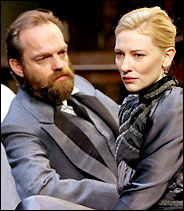 Hedda Gabbler was a woman of a completely different nature than Nora, almost her complete opposite. I never did quite grasp what Hedda was all about. Manipulative, deceitful, mean, but to what end? Especially given the final suicide scene. Was she just miserably unhappy and wanted everyone else to suffer? I didn't get it. It was certainly interesting as a psychological portrait of a woman, and was probably ground-breaking in drama for this theme. And I just found that Cate Blanchett played Hedda very recently. Again, I would like to see the play performed.
Read more . . .
Sunday, November 25, 2007
Pie Addendum
 As an update to my Thanksgiving post, I found out that at my grandma's house this year, the grand pie total was 35, with 28 different varieties. Amazing. They also managed to get 42 family members to the temple and completed 418 sealings and baptisms. And to think that AJ has never been to Franklin for Thanksgiving. We've got to make it out there sometime soon.
Read more . . .
Thursday, November 22, 2007
Stephenie Meyer, Take Three

I read the third vampire book this week. One thing I was puzzling over were Meyer's titles. To me, they aren't very evocative of the actual content. New Moon, Twilight, and Eclipse? I don't think that I can keep them straight. And the covers of her books are equally indistinguishable to me (but are definitely Bella-Edward branded). Why put a rose on one and a tattered ribbon on another? I'm sure there are good reasons for both the titles and the covers, but I don't know what they are.
Hmm. I liked this book ok. I think it was better than her second, but still doesn't match up to the first. I find Bella to be an annoying mix of "I'm strong and independent" and "Protect me, I'm fragile." I don't really find Edward to be a compelling romantic hero (but I don't see that in Jacob either.) I find her characters to be a little flat. The plot focus on the romantic triangle gets to be a little tiresome, the whole amazingly fast disappearance of the Volturi clan was puzzling, and the whole newborn vampire thread also disappeared amazingly quickly.
I like this review.
Read more . . .
Thanksgiving Pies
 I just put the pecan and derby pies in the oven. Last night, I baked an apple pie, and later this morning, I will finish with the pumpkin chiffon and lemon fillings. I have settled on 5 pies for this year, to share in a gathering of 7 adults and 4 children. I don't think that's overdoing it. I think around 1/2 a pie is just about perfect.
In my family, Thanksgiving, as for many families, is full of food traditions. My mother is the oldest child of 11. She grew up on a farm. A major Thanksgiving gathering at her childhood home, with her mother still at the helm , still takes place each year. I would guess that over the years, they have averaged 40-50 people each year, and it's probably gone done a bit since now there aren't quite so many kids.
Thanksgiving at Grandma's house was always entirely predictable. The stuffing recipe never varied, and was never fancy. The mashed potatoes never had garlic or rosemary, just butter and milk. And I always went back for seconds. And the rolls were just plain divine. With enough leftovers so that we could have turkey sandwiches later. That must be something like 150 homemade rolls. Amazing. It's been many years since I've eaten Thanksgiving dinner with the W family, so maybe something like Wild Rice-Walnut-Cranberry stuffing (a dish I'm making this year) is now on the menu. After all, the family has grown up and expanded, and there are several amazing cooks in the family with broad-ranging tastes. But, my guess is that no matter what more exotic dishes are on the table, all our old favorite stand-bys are there as well.
Living far away from the west for many years, we have had many Thanksgivings without family. In some years, members of AJ's family have come to visit. This year, his brother E is here. We've both made our own Thanksgiving dinners many times and shared Thanksgiving with others. Early on, I learned that, with their recipes, we could just about replicate the Thanksgiving dinner of the W's. Since then, although we've never completely abandoned tradition with Mexican food, for example, we've tried all sorts of variations of traditional dishes. AJ is always in charge of the turkey, and last year he went with Caribbean flavors. I think he used 20 lemons. This year, we decided to try brining the turkey. We'll see how it turns out. We like mashing Yukon Gold potatoes with cooked squash--the golden color is so beautiful on the plate. But, the one Thanksgiving food area where I haven't deviated (not too much, anyway) is pies. Pies were the crown of a glorious meal at Grandma's house in Franklin. And here, the W family swept tradition under the table. Why have baked pumpkin pie when you can have pumpkin chiffon or coconut cream or raspberry silk pie? There were always a couple of baked pumpkin pies at Grandma's, but they were the only ones with a few slivers left by the time Sunday afternoon rolled around and we were getting ready to drive home. With so many people attending, it was easy to justify making 30 pies. The variety was enormous. Only the very most highly desired pies--like banana cream--were repeated.
Making pies was a ritual. I remember watching my grandma and several of her sons and daughters rolling on pie crusts on her kitchen counter. And I can't forget the large container of lard that was used as the fat in the pie crust. Because of these childhood experiences, having some pie variety on Thanksgiving is essential for me.
One of our first Novembers in New Jersey, we ate Thanksgiving dinner with a family from our ward. I volunteered to bring, among other things, some pies. That morning, I got up early and started to make pie crust. I called Franklin to solicit some advice. My mom and my grandma and all her family made it seem so easy. I finally got some crust together, but was left with a mess and lots of stress. And it just didn't taste as good as theirs, of course. The pies were pretty good, but I felt like I was failing my W family, in a sense.
When we got to our dinner locations, I found out that the host had purchased some pies!!! And some of the other pie contributors used Pilsbury pre-made refrigerated pie crusts. And they turned out to be pretty good, unlike frozen crusts that I had tried earlier. I'm sure that the W family and other highly discriminating palates could easily tell the difference, but to me, it was a revelation. My pies didn't have to be just like my family's pies.
At that point, I decided to continue the pie making, but to leave the crust making behind. I still tend to apologize about it when we bring pies somewhere. I guess it's time I stopped. Giving up the homemade crusts felt like a big concession and almost a traitorous act, but in the end, for me, I decided it just wasn't worth it. In a way, it's sad that a domestic art like making pie crust hasn't survived from their generation to me (although lots of my sisters and cousins are experts at pie crust now), but in another way, it feels like just another way that I've blending my family traditions with my own predispositions and talents. I know my pies don't taste as good as those my W family will be sharing today, but for me, they're good enough.
Read more . . .
Monday, November 12, 2007
Scanning the Shelves: Finding Books to Suggest for Book Group

We are getting ready for our session to decide all our reading selections for 2008 book group. I love hearing about books and talking about lots of books and am looking forward to it. (And of course, I want to have a great list of books to read and discuss for next year.)
I've been thinking about what I would suggest for a while and have gone through multiple ideas in my head. Some fiction written in the last 10 years that I really like with interesting things to discuss (The Sparrow, Peace Like a River A Thousand Splendid Suns) and a memoir by Madeleine L'Engle about her marriage (Two Part Invention)--I thought it would be a nice look back at her life given her recent death. Even reading some of her YA fiction would have been fun. I also went through quite a few other titles, trying to read through them a little bit and find something that would be good for book group.
But, I ultimately decided to suggest books in areas where I felt I could make a "me" contribution, that would be a little different than what others might suggest. Two of my choices are in areas where I have done some reading and have a strong interest--Mormon studies and feminism/women's studies. Of course, I won't label them that way when I talk about them since that would almost certainly signal their death knell. I hope that my ideas don't die in flames. We'll see what the group thinks. And then one of my selections is a play. I really don't know anything about drama, but it seemed like a good and different kind of choice.
Here's what I just emailed my group about my choices:
1. Well Behaved Women Seldom Make History: I started thinking about this book as a possibility for our group when Christina mentioned Susan B Anthony. This is a new book by a women named Laurel Thatcher Ulrich who is a historian at Harvard and a member of the church. (This book has really nothing to do with the church, but I find Ulrich's personal story fascinating as a women who married and had children, and then went back to grad school in her 20's and 30's, taking a long time to finish, and then has become a very successful historian.)
The title of her book comes from her first published article when she was a grad student--some obscure journal. The phrase popped into cultural consciousness when some author picked it up for a book epigraph, and now it's found on bumper stickers, t-shirts, etc. Ulrich explores various women throughout history who have broken social conventions and made history in the process. (One of the women she discusses is Elizabeth Cady Stanton, an early suffragist and friend of Susan B. Anthony.)
This isn't an academic book, and I think there would be a lot of great things to talk about.
2. David O. McKay and the Rise of Modern Mormonism: This is a biography of David O. McKay published in 2005, but it is as much about how the church was transformed from a culturally insular Utah institution, with long white bearded prophets, to the global church that we now know.
The story behind how the book came to be is fascinating, and I will tell you more about that when we meet in December, but suffice it to say, the source material for this book is such that the curtain around the first presidency is pulled back a bit, and we can begin to see a little more the day to day workings of a prophet and the men (yes, mostly men, although there is an amazing woman who deserves her own biography) who work with him.
This book is very readable and is full of stories of the big personalities in the church during Pres McKay's tenure, included Ezra T. Benson, Bruce R. McConkie, and Ernest Wilkinson.
Very interesting, lots to talk about.
3. Wit--this is a short Pulitzer prize play written in the last 10 years by Margaret Edson. It is about a English professor who specializes in the poetry of John Donne who is very sick with ovarian cancer. The majority of the play takes place in her hospital room.
Here's a description from AmazonMargaret Edson's powerfully imagined Pulitzer Prize–winning play examines what makes life worth living through her exploration of one of existence's unifying experiences—mortality—while she also probes the vital importance of human relationships. What we as her audience take away from this remarkable drama is a keener sense that, while death is real and unavoidable, our lives are ours to cherish or throw away—a lesson that can be both uplifting and redemptive. As the playwright herself puts it, "The play is not about doctors or even about cancer. It's about kindness, but it shows arrogance. It's about compassion, but it shows insensitivity."
In Wit, Edson delves into timeless questions with no final answers: How should we live our lives knowing that we will die? Is the way we live our lives and interact with others more important than what we achieve materially, professionally, or intellectually? How does language figure into our lives? Can science and art help us conquer death, or our fear of it? What will seem most important to each of us about life as that life comes to an end?
Again, lots to talk about. And HBO has made a film of Wit, which retains most of the qualities of a play. Emma Thompson stars. Excellently done.
I have read probably the first 75 pages of Ulrich's book and I love it so far. Really a lot to think about in the intersection of women and history. I was so inspired by Ulrich's preface--which is somewhat of a personal essay--that I ordered her book A Midwife's Tale which won a Pulitzer and several other prestigious history awards. And then after reading her first chapter, I put material by and about Virginia Woolf and Elizabeth Cady Stanton on my Amazon wish list. And I also ordered a copy of this book to have. I'll write more about it when I finish it.
I've been thinking about the David O. McKay book for a long time. In fact, I suggested it for my Pittsburgh group, and then moved before they did it. I think it would be a great choice, and it's not dense. Lots to think and talk about.
I almost suggested Ibsen's A Doll's House and Hedda Gabbler for my third choice. I just read A Doll's House to review it and see what I thought. It was an interesting play, but there were some things I didn't like about it. It had a similar theme to The Awakening which we did this year , but I thought that the story did not develop nearly as well here as Chopin's. The ending was abrupt. I would like to see it performed, because I did like it. But, I just thought maybe something different would be better. So, I went with Wit, another play with interesting ideas.
Read more . . .
Sunday, November 11, 2007
Austenland
 This was the selection for book group for November. We picked it last December before it had been published so no one had read it. Although some members of the group enjoyed it, it was too frothy for me. Especially for a book group selection. As a book to read on my own? Borderline fluffy, even for that. I didn't love the story, I thought the characters were a little weird, and I thought the whole premise was strange. I'm not an Austen devotee and I haven't watched P&P with Collin Firth innumerable times, so maybe that's why I just couldn't relate.
I much prefer Shannon Hales' YA books. I think I will pick up The Book of a Thousand Days and see how I like that.
Read more . . .
A Thread of Grace
 I started reading Mary Doria Russell's latest book in Italy and finished it when I got home. This is a historical fiction book set in northern Italy in the last months of WWII after the Italians surrendered and when Italy was being occupied by Germans. She tells the story of the poor hill people and others in larger cities who help the resistance movement against the Germans and who hide Jews. I started it thinking I might recommend it for book group, but it's a definite no.
There's a saying in Hebrew, he tells her. 'No matter how dark the tapestry God weaves for us, there's always a thread of grace.'
Read more . . .
Thoughts from stake conference and 1 Nephi 1
This weekend is stake conference and we attended today and last night. I have a great admiration for our stake president and find his words inspiring and riveting. Today, his talk centered on spiritual safety and how gathering to the stakes of Zion facilitates that.
It was very much a "discipleship" kind of talk. I've been thinking about this a little while. I like general direction on how we can have the Spirit, on becoming followers of Christ. Pres P is putting the onus of most of the specifics on us, it seems. This is very different, to me, than the talks I've heard directed to women, for example, where there are a litany of specific directives without an overriding theme of personal revelation and finding a good fit for our personal circumstances. While I see the need for specific talks about being a member missionary (what our mission president and his wife discussed), I much prefer the idea that when I am living my life in a way that I have the Spirit guiding me, I will be inspired with regards to missionary work (or parenting or whatever happens to be the most important thing for me at the moment). Pres P's counsel seems always applicable, while very specific talks might not be at a given time. And while I need to hear counsel about home storage and financial preparation, I appreciate it so much more when it is contextualized within the larger gospel. There are a lot of things from his talk that I need to process.
One of the specifics things that he talked about was the Book of Mormon and scripture study as a key way to invite the spirit into our lives and prevent ourselves from becoming spiritually complacent and cut off from the presence of the Lord. He asked us to read the Book of Mormon in its entirety before our next stake conference, and while I think that there are better ways of studying the scriptures than chronologically, right now I am hardly getting any scripture study in at all, and in sequence is better than nothing for me right now.
I came home and started with 1 Nephi 1. Just a few thoughts. In some ways, I wish I could read it more naively or unquestioningly, like I used to be able to in the past. I have a lot of questions and sometimes concerns about what I read, and it can sometimes be a distraction.
Today, the first sentence of the introduction to 1 Nephi bothered me: "An account of Lehi and his wife Sariah and his for sons". We know Nephi had sisters. What of their spiritual journey and their attitude to their father's requirement to leave Jerusalem? We know nothing about them. Did they chose to follow Nephi? Or L&L? Or were they more like Sariah lacking some faith, but following along anyway? They are just completely absent from any narrative here and that makes me a little sad.
When the text turns to Lehi's vision, I wondered if women ever get to have visions like this. Even if they do, they aren't recorded, and so it's hard to get our minds around the idea that experiences like this are possible for women. (or is this a special prophetic vision, which would of course be limited to a very narrow category of men?)
The other thought that I had was from v. 3 where Nephi tells us that the words he writes are TRUE. I wonder about truth. Yes, he is recording what he perceives is true. But, 1 Nephi is written at what, a 20 year distance? So, memory might be an issue. And I wondered if Nephi was able to use Lehi written account as a text from which to base his words. His perspective from a 20 year vantage point on L&L might be skewed, because he knows they never repent, so maybe he focuses on the negative in them and the bad choices they make. And then there's the women in his account. While what he writes may be true, he has certainly chosen to exclude certain things.
All that said, I was impressed with the power of the book that the Savior gave Lehi and the impact that it had on him. I read some other verses from the Bible about sacred books and how they are used. I love Jeremiah 15:16:
Thy words were found, and I did eat them; and thy word was unto me the joy and rejoicing of mine heart; for I am called by they name, O Lord God of hosts.I am going to do better with making scripture study a higher priority and more consistent habit.
Read more . . .
Friday, November 02, 2007
Verona
There is no world without Verona walls,
But purgatory, torture, hell itself.
And world’s exile is death;
--William Shakespeare, Romeo and Juliet, Act III, Scene III

Anyway, Verona is only an hour's drive from Vicenza, so it is much more doable. I think T would have been fine on the bus, but it was sure nice to go on my own. After driving through the city, we went to the Giardino Giusti, a Renaissance era garden of a wealthy Veronese family. It seemed to be dedicated to Bacchus, as there were several statues of him around. At the top of the hill, there was a giant monster like face with its mouth open and they could light a fire inside the mouth. Supposedly, it was a place where philosophers and other thinkers gathered to talk (and party too). There were rows of tall pointed cypress (I never really knew what they looked like before) a lot of shaped hedges, and a small maze.


Then, we walked over the river and went into the main city area. We saw the Gothic tombs of several of the members of an important Veronese family, Della Scala. The three males were nicknames Cangrande, Il Mastino, and Cansignorio--Big Dog, The Mastiff, and Mr Dog. They were memorialized with big statues on pedestals.

And surrounding the area was an iron gate with each little intersection including the Scala family crest, including a symbol of a ladder or scaletta in Italian. You can't see it well in the photo, but here is the crest.

When Dante was in exile from Florence, he stayed for quite a while in Verona with Cangrande hosting him.
And of course, we went past the Romeo and Juliet sites. I saw Juliet's house the last time we were in Verona, which was a good thing because it was completely mobbed this time around. I find the great tourist attraction to this pseudo-historical site to be laughable. There is a home that would have been similar to Juliet's home, complete with balcony, which tourists come to gawk at. The name of the family that owned the home was the Cappellos, similar to Shakespeare's Capulets, which probably triggered its original link to the fictionalized Juliet. In the small courtyard, there is a statue of Juliet, and supposedly, if you put your hand on her right breast, you will have luck in love. (Ugh. What kind of horrible tradition is that? I refused to participate and I didn't let AJ either. I can't remember if he wanted to or not.) As a result, the finish on her right breast is completely worn off.
I also saw the Roman era arena. It is right off the main piazza at the entrance to Verona's city center.
 It doesn't have the majesty of the Colisseum, mostly because the interior was currently set up with lots of chairs and a stage--it is used during the summer season as a performance venue. AJ's parents saw a performance of a Romeo and Juliet opera there this summer. With the Colisseum, you can see all the excavated cavities under the main arena floor.

And here is a medieval bridge, the Ponte Scaligero, built by Cangrande. After the Germans blew it up, the Veronese dredged the river to salvage the masonry in order to rebuild it.

Read more . . .
Monday, October 29, 2007
Down's Syndrome Scare
 AMA: American Motorcycle Association? Academy of Model Aeronautics? American Medical Association? No, no, and no. My most recent encounter with this acronym was last Thursday when I went in for my Level-2 ultrasound.

 Oh, and although we saw really clearly on the ultrasound (I love this shot AJ described as baby porn) , the chromosomal tests confirmed that our baby is XY all the way. T has decided that we should name the baby Sportacus. I think it sounds great with out last name, and so we will be calling him that for the duration of the pregnancy.
Read more . . .
Thursday, October 18, 2007
Market Day

 Tuesdays and Thursdays are market day in Vicenza. Starting around 8 in the morning, the entire piazza and up the side streets are filled with vendors hawking their wares under tents. Just the sheer logistics of getting their goods in and out of selling areas is remarkable. I love walking around, looking at all the clothes and the people who are are out shopping. There is always a good lively crowd--older women in heels and suits with perfectly coiffed hair, mothers with their babies in strollers, young people. It feels like
 the whole of Vicenza comes out for the market. Forget about Target or the grocery store. So much of what you need is right there. Clothes of all types, ties and scarfs, knick-knacks, kitchen pots and pans, tablecloths and blankets, plus produce, fish, cheese and flowers are all available within feet of each other. In a short time, you can gather everything you need.
 I think the picture that T took of Nana at the market is pretty good, by the way.
Read more . . .
Nove and Marostica
 On Monday in the late morning, we made a trip over to Nove to look at the ceramics. TF took T to the zoo and playground in the area, and C and I went over to the ceramics stores. The warehouse type store is piled high with ceramics of all varieties, and I kept envisioning T running through the aisles. Happily, he was otherwise engaged. I picked up a couple of platters for gifts that I needed to give, plus a huge mosaic platter of Florence that I will put in our front room. Unfortunately, they did not have all of the colors of the chicken plates I wanted to get my mom for Christmas. I think we will go back on Monday so I can pick those up before we leave.
 Then, we went over to Marostica for some lunch. T was very cranky, very contrary, but after eating, he seemed to be doing better. Marostica also has a city wall, but is unique because the wall was built up a steep hill with a castle at the top. You can see the wall in this photo. Not the best shot of the main piazza--there seemed to be cranes all over Italy. T had a great time swinging his sword around in front of the castle at the base of the hill too.
Read more . . .
Two more Italian Books
I have been working on a couple more books about Italy on this trip.
 First, Brunelleschi's Dome: How a Renaissance Genius Reinvented Architecture by Ross King is about the completion of the dome of the Duomo in Florence. It is interesting, although it was a little technical for my taste, with a few too many details about the engineering feats Brunelleschi accomplished. I was suprised to learned that the dome is one the largest ever built--massive in its entirity. Brunelleschi not only had to design a dome that would not collapse under its own weight (using innovative techniques such as a double dome with empty between the two layers, a herringbone pattern to lay the bricks in order to provide strength, and a chain of stone built within the brick to provide support) , he also invented a machine to lift the heavy beams and slabs of marble to several hundred feet above the ground and figured out a way to erect the dome without the use of centering--wooden frames used to hold up the arch. There is also some information about Brunelleschi's personality.
 Second, Sprezzatura: 50 Ways That Italian Genius Shaped the World is 50 essays that can be read individually about 50 mostly individuals (but a few other Italian phenomena--Venice, Roman building advances, Medicis and banking, and Italian fashion for example). Starting from the Roman period, the authors move to contemporary times. I read probably 75% of it, focusing on the earlier periods of Roman and Renaissance contributors. Each essay felt a little too packed with details, but overall it was interesting. After reading it, I decided that I had missed out on some classical literature, including Ovid, Dante, Petrach, and Boccacio among others. I almost persuaded myself to read thier major works. But, when I saw The Divine Comedy and Decameron in a Florence bookstore, I rethought my noble idea and decided to put this on my back burner book list. Maybe I could read a little bit at a time some other time??? Among the more interesting essays, I enjoyed learing the development of the modern calendar and Julius Ceasar's involvement with it (perhaps because it was the first one in the book). I also enjoyed reading about the figures of the Renaissance like Michelangelo, Galileo, Machiavelli, da Vinci, the Medicis, and Palladio.
Read more . . .
Thursday, October 11, 2007
Thiene
I enjoyed a quasi-feeling of having the day off on Sunday. On a General Conference weekend, a broadcast of the first session occurs at the church, but it doesn't take place until 6 pm. The men went over to the church at 11 to watch a taped copy of the priesthood session. But, C, T, and I went out for a walk. It was a beautiful morning and we walked over to a statue garden where a remnant of Vicenza's city wall stands. T had fun looking at the fountains, ducks, statues, and trees, and then we strolled over to a park-like area. It was very casual, very relaxing.


Read more . . .
Wednesday, October 10, 2007
Rainy Day
After an excellent first day, both T and I were exhausted on Saturday. For some reason, I was awake early that morning from 2 am-5 am. I'm not sure if it was the jetlag or the pregnancy induced insomnia I have occasionally experienced, but I didn't get out of bed until 10. With T, it was more like 11:30. After we finally got out of the house around 1:30, we drove over to the post so that T could get a soccer ball to play with at the park at the piazza. By the time we were done there, it was pouring rain. A heavy downpour. We waited a while to see if it would let up and then finally TF ran out for the car and we jumped in. We had planned to go to the Renaissance Festival in Thiene, but decided to postpone the trip. Good choice, because the rain didn't let up all afternoon. We ended up driving back into Vicenza the long way because of multiple detours due to the soccer game there. I guess there is no calling off an Italian soccer match. But, I got to see the outskirts of the town, and one of Andrea Palladio's (famous Renaissance architect son of Vicenza) most well known villas, which has been copied many times over.
We relaxed the rest of the day. I took a small nap in the late afternoon, and then we booted up the computer to listen to the first session of General Conference, at 6 pm.
Oh, and one thing I did in the middle of the night, as well as the previous and next day? About 10 NYT crossword puzzles from TF's "Solvable" collection.
Read more . . .
Citta Della


Read more . . .
Italy Adventures
 T and I made it to Italy last week. The weather has been absolutely beautiful and Italy is enchanting. We are looking forward to AJ and MJ's arrival tomorrow afternoon, and I have been working on the details of our trip to Pisa, Lucca, and Florence next week.

This is a view through the gate of the Teatro Olympico, dating from the mid-1500's, from the first morning's walk with TF.

This is a Palladian palazzo a few minutes walk from AJ's parents house.
Read more . . .
Friday, October 05, 2007
Frankenstein
For book group this month, we did Frankenstein. I was a bit behind in my reading, so read through it in a couple of days. Kinda crazy book. I didn't like the monotone voice--the ever present Mary Shelley--of all the characters. Ever the monster spoke in the most educated and vocab filled voice in his 6-8 chapter monologue (after learning to speak by watching cottagers teach an Arabian woman to speak French--he also learned all about geography, politics, etc. In fact, after these experiences, he devoured John Milton's Paradise Lost.) I could not lose myself in her fantasy world. It just didn't work for me. The women portrayed in the book drove me crazy--very one-dimensional and the very idea of a Victorian woman. Who is that perfect???
But, it was a decent read. And I guess there were a few of those timeless themes that supposedly help to make a book a classic. I thought Victor was crazy and irresponsible. I couldn't believe that he just left monster-man (a much more sympathetic creature to me) and for two years didn't do anything about his creation. It was only after the death of his brother that he was forced to deal with the situation. It reminded me a bit of the movie AI. What is our responsibility to those things that we create?
Read more . . .
Saturday, September 29, 2007
Galileo's Daughter

This is my first read in getting prepped for our Italy trip. AJ's mom recommended it to me and I really enjoyed it. Dava Sobel, the author, retranslated the enormous number of letters from Galileo's daughter, Soeur Maria Celeste, a cloistered nun to shed light on what was probably Galileo's most important relationship in his life while at the same time telling the story of Galileo's life. Galileo is from Florence, and lived in Pisa, Padova, and Siena, all places I hope to visit. Maybe we can even see his grave or the place where he was under house arrest. I love that his daughter, upon becoming a nun, changed her name to include Celeste--I think it was in tribute to her father who had recently discovered 4 Jovian moons and refined the telescope in order to better study celestial phenomena. (One of the reasons that I love the name Stella is that it means star in Italian.)
The whole conflict between Galileo and his helio-centric model of the "universe" and the Catholic church is fascinating and troubling. This book makes me want to read an overall history of the tensions between science and faith. I couldn't believe that G.'s Dialogue, in which he tries to avoid the wrath of the Catholic church by using 3 fictional characters to discuss the earth- and sun-centered models of the universe, remained on the Catholic church's list of banned books until the mid-1800's--a total of 200 years after G wrote it. I would like to see if the Catholic church apologized and/or responded when incontrovertible evidence emerged proving that the earth was not the center of the universe.
The rationale for their objections to G's work was that the helio-centric model contradicted scripture. Leading clergy and the Inquisitorial officials pointed to maybe 3 or 4 scriptures in the Bible as their evidence. Chief among then was the story of Joshua where the sun stood still. What was surprising to me was how much weight the Pope and church put on an issue that I see as having very little relevance to issues of salvation or any of the core tenets of Christianity. Why was this so important to them? The alternative models that are required to keep the sun moving around the earth are so complicated and distorted as to be farcical. My favorite is the system of Tycho Brahe where Mercury, Venus, Mars, Jupiter and Saturn rotate around the Sun while the Sun circled the stationary Earth.
There was no discussion in the book about whether G questioned the Church's position in either this specific regard or in general. He remained a faithful Catholic his entire life, despite the treatment he received at the hands of Catholic authority.
And a great quote by G's father Vicenzio:
It appears to me that they who in proof of any assertion rely simply on the weight of authority, without adducing any argument in support of it, act very absurdly.
Read more . . .
Friday, September 28, 2007
Mindless Eating

Read more . . .
Tuesday, September 25, 2007
Pregnancy, the Third Time Around
I am now 17 weeks pregnant. I think that this past weekend, I started to feel the baby moving. But, I still don't feel connected much to the baby, and it really doesn't seem too real yet. I haven't been thinking about names, haven't started wearing maternity clothes, and am not really "excited" yet. (It seems like when people hear you're pregnant, they're excited for you and expect you to say that you're excited. I'm not sure how to describe what I'm feeling. Just fine about it, I guess.) I haven't told a lot of people in my ward yet, just because I feel kind of awkward about it. "Ahem. Attention everyone. I have an announcement to make." If the discussion comes around to babies, I mention it. But, I feel like there are a few more people that I need to tell before it's totally obvious just by looking at me. I think that when we find out what the baby's sex is and when the baby starts moving around more that I will start to get more into it.
There is a woman in my ward who is only a few weeks ahead of me. She is really petite, so it is obvious that she is pregnant. But, her pregnancy behaviors are surprising to me. Her hand always on the belly. Using her belly as a little shelf. The pregnancy walk. I doubt these things are conscious, but it seems too early for her to be doing all those things since I can't imagine myself doing those things in a few weeks. I'm sure it speaks to differences in our dispositions, and possibly even differences in our feelings about motherhood.
Then there's the "high-risk" thing. Ever time I've gone to the dr, it's come up. My age. And how my chances for x,y, and z are higher because my age puts me in the high risk category. At times, I was convinced that our baby would have Down's. I was relieved when the results from the maternal serum test came back normal. I have to get the super duper extra long ultrasound to check for a lot of extra stuff. I hope they stop mentioning it once that is done.
This summer was quite a low point for me. I think a few things contributed. MJ was not in school at all--the kids were always driving each other crazy and driving me crazy. The bickering seemed incessant and I felt like I couldn't go through a day without at least a minor breakdown. T stopped napping as soon as we got back from vacation. This was just the time when I started needing a nap every day. The first trimester exhaustion felt debilitating and I could hardly handle routine housework. The kids were just plain overwhelming. (A nice way to start a pregnancy. I can't even deal with the kids I have now. What'll it be like with a newborn?)
And I had so much rage. I don't know if it was hormonal or if it represented an emotional blowout of all my motherhood issues. I felt perpetually angry. It was a physical feeling in my chest and throat and I could scarcely contain myself. (I often did not.)
This is something I wrote in the middle of this summer about my anger:
I feel so angry lately. Is it because I am pregnant? Other women get emotional when they watch cheesy commercials, but I am angry. I have no patience with the kids. The smallest thing sets me off. I am going to ask the nurse this week if this could possibly be related to being prg. When I was p with T I was also angry during the first trimester, but I thought it was because I had been reading the Price of Motherhood. And because of all the crazy things that happened to me that first little while with the temple and how I felt like he was a girl, but then found out he was really a boy. I felt angry. I had to leave General Conference when I heard a woman equating motherhood with sacrifice. I just was angry.
Now, seeing how I am feeling right now, without all those external stresses that I had before (right now, I haven’t thought about the baby’s sex, things have been pretty calm, except for the transition to summer time and no nap for T) but I am angry. Maybe I will google it later and see if other pregnant women feel anger too. Could it be hormones? I would like to attribute it to that, but don’t know if I can. At least not completely. My kids are driving my crazy and I feel mad about having to stay home with them. I have no energy to do anything and my house is a mess right now. I am angry. How do I deal with this situation? I am not sure.
Structure. Maybe I just need more structure in our lives. I don’t like unpredictability and it seems like there is just so much open time in the days where I feel like I can hardly move. Should I let Toby stop napping? Would that make it easier to deal with my days? Or harder?
When I read Terry Tempest Williams' quotation about the moon and our energy, it resonated with me and I had hope that I would not always be in the crescent (or even new) moon stage. And sure enough, with the passing of summer, MJ staring 1st grade, and the end of the 1st trimester, I have felt a lot better. I don't remember the last time I needed a nap, and my moods are so much more even.
Read more . . .
Refuge and Faithful Transgressions
 I have been needing to catch up with a few words on some books that I read this summer. Refuge by Terry Tempest Williams and Faithful Transgression by Laura Bush are companion volumes somewhat. We read Refuge for Sept book group (but had a low turnout after the woman who suggested it made a disclaimer that she didn't know about the "seeds of apostacy" that she found in it. I vehemently disagree with this analysis of the book. Non-orthodox thoughts will not necessarily set someone on an incontrovertible path towards an apostate life.)
Bush analyzes 6 Mormon women's autobiographical writings who cross boundaries. She spends some time discussing her notion of trangression as boundary crossing, using Adam and Eve as example. I liked her introductory discussion and the notion that she develops of the contradiction, yet wholeness, that she finds in women who have crossed Mormon boundaries. I didn't finish all 6 of her biographical chapters. It was a bit academic, but still interesting. Anyway, one of the women that she discusses is Terry Tempest Williams, together with a memoir entitled Refuge.
I really loved Refuge and found the controversial issues to be a very overall small part of her book. In fact, I think that Bush makes too much of them in her analysis. There is no lengthy discussion of any one particular "boundary-crossing" issue--this book is about Williams' mother suffering and ultimately dying from ovarian cancer. And it is about Williams connection to the land of Utah. She has an amazing ability to sit and absorb nature. Her particular love is birds, and her book is full of descriptions of birds and their habitats and what happened to them as Great Salt Lake flooded in the 1980's.
It's been about a month since I read it and a couple of things still stand out to me.
I loved her use of the moon as a metaphor for our emotional energy. In a brief passage, she says, "As women, we hold the moon in our bellies. It is too much to ask to operate on full-moon energy three hundred and sixty-five days a year. I am in a crescent phase." I love the notion that our energy cycles like the moon and that behind a crescent or new moon phase, the full moon exists--it just may not be evident at the moment. I was certainly in a crescent phase this summer.
I also was astounded by her connection to a geographical place. I think it's due both to her predisposition to pay attention to and love nature and to the fact that she has lived in the same place her whole life. But, moving around a lot isn't a good excuse for me. After reading Refuge, I determined to find ways to become more connected to the area where I live. To research and give labels to the trees in my neighborhood. To spend time walking around lakes and on the numerous trails in the area. To take advantage of the many wonderful outdoor center activities. And to encourage my kids in the same way.
When we first came here to look for a house, all the commercial areas were so familiar. "Here's a complex with Target, Pier One, Old Navy, and Starbucks. Oh, and just up the road in this other suburban town is the exact same thing." These complexes look just like so many others across the country. The homogenization of America. My conception of place was centered more in commercial enterprise rather than landscape. And now that we have lived in Minnesota for more than a year, there are clearly many things that distinguish it from Pittsburgh, New York, and New Jersey. I love the amount of sun we get compared to Pittsburgh. I often am in awe at the vastness of the sky and the beautiful clouds scattered across it, especially at sunset. And of course, the sheer number of lakes and ponds. But, I regret that my first impression of this place that is now my home was based upon something much different.
Read more . . .
Saturday, September 15, 2007
Off-Ramps and On-Ramps

Sylvia Ann Hewlitt's new book Off-Ramps and On-Ramps: Keeping Talented Women on the Road to Success is a book about how corporate America can restructure work to help women create non-linear careers. She uses a variety of case studies from companies like Ernst and Young and Lehman Brothers, who are implementing cutting edge policies, to discuss what work life balance can look like and mean for women employers. She focuses on the needs of mothers, but also of women who are elder caregivers, and generalizes to the entire working population who may need work flexibility. I found it somewhat interesting, but had a couple of general thoughts and some specifics.
This book is focused on a very narrow sub-set of working women: women who are high achievers in corporate America. Women at the top of a very particular group of employees. These are women who are earning lots of money in consulting, investment banking, and other such jobs who want to scale back their careers for a time. Maybe these are the early adopters who will pave the way for flexible work arrangements for a much wider variety of work, but the economic benefits of retaining women seems to be greater in a corporate setting than in many other employment arenas.
And what happens if the economy starts to shrink and companies need to downsize? Will they be able to maintain these same kinds of policies to keep women able to balance work and life? I also wondered about how applicable these types of policies are for small companies. They can't afford to have elder care consultants working with employees to solve problems with elderly and sick parents, for example.
It was also very much targeted at corporations who want to implement policies, making it somewhat less interesting for me as an individual concerned about these issues, but from the other side of the table. Yes, I'd love to find a flexible job arrangement!! How these policies relate to academic jobs is completely unclear and I have no idea what universities are doing in this arena. And how can I find a job that is flexible? I'm not sure.
But after reading, I thought maybe I should have gone into business or some other area that would be better suited for part time/flexible work. Some area where the skills are in greater demand than in academics. And I also started thinking (AGAIN!) about how to go about finding a job that is flexible and part-time. I need something. I want something. I keep thinking about that time (6 years from now) when all my kids will be in school and what I will be doing. I need to be doing smaller things now so that I can have an entry point then. So, I'm going to finish updating my vita and send it out to a bunch of places and send in that paper for review to see if I can't get it published. And look into as many options as I can find that might provide me some opportunity to use these skills
Read more . . .
Reading analysis
I want to do a little analysis of my reading habits over time after looking at an NPR article that S sent me about women reading more than men and reading more fiction than men. I want to see how much I've read over the last few years, as well as the breakdown between fiction and non-fiction. Starting in mid-2004 I started recording all the books I read in a little book, so to go completely digital, I will transcribe them here.
Moneyball by Michael Lewis, NF, May 2004
The Secret Gospel of St Thomas by Elaine Pagels, NF, May-June 2004
The Red Tent by Anita Diamant, F, May 2004
(These were books I worked on when AJ and I went to North Carolina for a get away when I was pregnant with. Doesn't seem like it's been 3+ years since then.)
Da Vinci Code by Dan Brown, F, Aug 2004
The Life of Pi by Yann Martel, F, Sept 2004
The Namesake by Jhumpa Lahiri, F, Sept-Oct 2004
Gift of Fear by Gavin de Becker, NF, Nov 2004
Interpreter of Maladies by Jhumpa Lahiri, F, Dec 2004
Embers by Sandor Marai, F, Nov-Dec 2004
Under the Tuscan Sun by Frances Mayes, NF, Dec 2004-Jan 2005
The Not So Big House by Sarah Suzanka, NF, Jan 2005
Bliss by Ronit Matalon, F, Jan 2005 (wow--I barely remember this one. )
Consuming Kids by Susan Linn, NF, Feb 2005
Born to Buy by Juliet Schor, NF, Feb 2005
Gift of Love by Marc Gafni, NF, March 2005
Families that Work by Gopnick and Meyers, NF, Apr 2005
Angels and Demons by Dan Brown, F, Apr 2005
The Culprit and the Cure by Aldana, NF, Apr 2005
Perfect Madness: Motherhood in the Age of Anxiety by Judith Warner, NF, Apr 2005
The Childhood Roots of Adult Happiness by Edward Hallowell, NF, Apr 2005
The Great Divorce by CS Lewis, F?, May 2005
David O. McKay and the Rise of Modern Mormanism, NF, June 2005
Harry Potter and the Half Blood Prince by JK Rowling, F, July 2005
Blindness by Jose Saramago, F, July 2005
The No 1 Ladies Detective Agency, F, Aug 2005
Map of a Child by Darshak, NF, Aug/Sept 2005
Woman: An Intimate Geography by Natalie Angier, NF, Sept 2005
City of Falling Angels by John Berendt, NF, Fall 2005
Waiting For Birdy by Catherine Newman, NF, Sept 2005
1-2-3 Magic (Parenting book), NF, Fall 2005
The Sparrow by Mary Doria Russell, F, Fall 2005
Blink by Malcolm Gladwell, NF, Dec 2005
Prodigal Summer by Barbara Kingsolver, F, Dec 2005
Michelangelo and the Pope's Ceiling by Ross King, NF, Dec 2005
(I read these on our trip to Italy)
Medici Money by Tim Parks, NF, Jan 2006
Bella Tuscany by Frances Mayes, NF, Jan 2006
Faster by J. Gleick, NF, Feb 2006
An Italian Education by Tim Parks, NF, Feb 2006
The Wonder of Boys, NF, Feb 2006
Pedestals and Podiums by Martha Sonntag Bradley, NF, Mar 2006
I got this one from The Strand after I defended my diss
Children of God by Mary Doria Russell, F, Mar 2006
Rough Stone Rolling by Richard Bushman, NF, Mar-Apr 2006
Freakonomics by Steven Leavitt, NF, May 2006
The World is Flat by Thomas Friedman, NF, May 2006 (didn't finish)
Julie and Julia: My Year of Cooking Dangerously by Julie Powell, NF, May 2006
The Kite Runner by Khaled Hosseini, F, May 2006
(These four I read on our cruise)
And I think from here, I started keeping track on my blog
So, from May 2004-May 2006, I read 46 books, and 35% were fiction.
Since July 2006, I have read 42 books (that picked up quite a bit with no diss to worry about). 16 were fiction and 26 were non-fiction, for a total of 38% fiction. Not too different from before.
In the NPR story, there were no statistics on what the proportion of fiction to non-fiction is for women readers, only that women read more than men and read more fiction than men. (Only 20% of fiction readers are men.) So, I have no idea where I fall in general reading trends. They do report that among avid readers, women read 9 books per year. What does that make me? I must fall in the major nerd category.
Read more . . .